If Gemini Rue had
been released 15 years ago, it would be remembered today as a classic. But the
gritty, sci-fi thriller was instead released in 2011 and serves as a nostalgic
reminder of the heyday of point-and-click adventure games. Part Blade
Runner, part Beneath a Steel Sky, it's a game that doesn't attempt
to do anything new. Instead, it does something old very, very well.
Gemini Rue is
a detective story. At least, that's how it begins. You play as Azriel Odin, a
tough, trench-coat wearing cop stuck on a planet of perpetual rain and run by a
criminal syndicate known as the Boryokudan. When a meeting with an informant
falls through, Odin finds himself struggling to gather the information he needs
to find his missing brother. At the same time, in a rehabilitation facility
hidden deep in space, a man known only as Delta Six finds himself without any
memories. A mysterious director guides him through his rehabilitation, but what
he's being rehabilitated for he doesn't know. Meanwhile, other patients attempt
to curry his favor. But why? And who should he trust?
Who am I?
You'll play as both of these characters
throughout the game, and their stories intersect in surprising and clever ways.
It's not what you initially expect. The story at first appears to be little more
than a spin on Blade Runner, but as it unravels, Gemini Rue is
able to stand on its own. The tale is dark: people die and complicated issues
are addressed. Themes of betrayal, predetermination, and the importance of
memories are interleaved throughout.
The story is certainly engaging, with a
small yet solid cast of characters and a fantastic closing sequence, but what
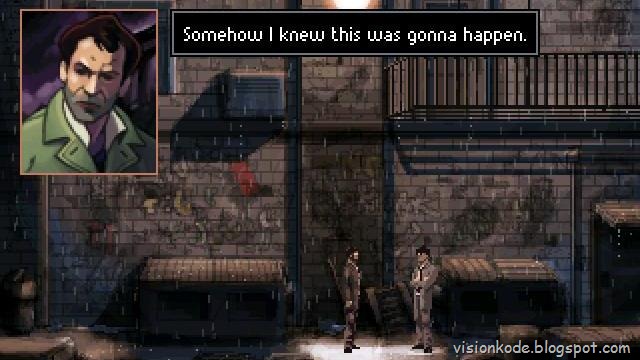
really makes Gemini Rue is its atmosphere. The noir-esque tone is set
immediately, with falling rain, retro-futuristic technology, and a dark but
subdued musical score. Odin is a cop with a past he wants to forget and a
partner who doesn't trust him. It would almost feel clichéd if it wasn't done so
well. And while the visuals are decidedly retro, they are no less impressive for
it.
Gemini Rue is simply a
beautiful game. What the developers have managed to do with the limitations of
pixels and sprites is incredible, and the art boast an amazing level of detail.
Things get less impressive when you leave the dark, run-down planet surface and
enter the sterile, stark-white rehabilitation center, but it still looks great.
The only real issue visually is the inclusion of bland, out-of-place character
portraits that thankfully can be turned off completely. They only obscure the
detailed backdrops anyways.
The stellar production values and solid
writing are able to almost entirely mask the fact that the game uses a formula
that hasn't really changed in over a decade. You interact with the world using
the simplest of commands—an eye to look at something, a word bubble to speak.
It's archaic in a lot of ways, but also cozily familiar. If you've played an
adventure game before, there isn't much you need to learn in Gemini
Rue. The one possible exception is the curious inclusion of cover-based
combat, which will occasionally have you trading bullets with enemies. It's
simple enough, though, and there's a pretty extensive tutorial disguised as a
rehabilitation training session to guide you through the process.
Something old, nothing new
This also means that the game is subject to
many of the frustrations of the genre. The puzzles are generally intuitive and
don't require any bizarre solutions. Problem is, though, that because the game
world is frequently so dark, it's pretty easy to miss certain small, hidden
clues, which results in the always dreaded pixel hunt. This is alleviated
somewhat by a few clever additions, including a computer network that you can
search for clues and a cell phone-like communicator you can use to call for
help.There's also at least one poorly constructed minigame that has you guiding
a spaceship via a radar. It poses no challenge and is incredibly tedious.
But with a game like Gemini Rue
you should already know what you're getting into. It uses a formula that's
already well-established and doesn't veer from the course. What it does so well
is accentuate the strengths of that formula by presenting a gripping narrative
coupled with a convincingly beautiful presentation. It's a love letter to
adventure gaming, but at the same time it stands up as a thoroughly enjoyable
modern release.
Verdict: Buy