TIME

Showing posts with label nokia. Show all posts

Monday, 27 February 2012

MWC 2012: Nokia reveals 41MP cameraphone…

A 41-megapixel Nokia smartphone was among the new technology on show during the opening day of Mobile World Congress in Barcelona.


 The 808 Pureview offers enhanced low-light performance as well as sophisticated image compression designed to help users share pictures.
Nokia hopes to regain ground lost to Google and Apple in the mobile market.
However, some have criticised Nokia's decision to use its own operating system, Symbian, on the device.
Nokia's other smartphones typically run on Microsoft's Windows Phone software.
Symbian, which first appeared on Nokia phones in the 90s, is widely regarded as inferior to the app and social media-driven Windows Phone system.
"The Pureview 808's Symbian Belle operating system might detract from its appeal to a broader market, where it deserves recognition," said Tony Cripps, a principal analyst with Ovum.
"It's a pity that Nokia was unable to combine the photographic prowess of the PureView 808 with the style of the Lumia 900.
"Such a device may well have been the first smartphone to truly deserve the title of 'superphone'."


'Breathtaking'
Nokia claims the 808 sets a "new industry standard" in mobile imaging devices.
"People will inevitably focus on the 41 megapixel sensor," said Jo Harlow, executive vice-president of Nokia smart devices.
Nokia say the 808 will set a "new industry standard" for mobile imaging
"But the real quantum leap is how the pixels are used to deliver breathtaking image quality at any resolution and the freedom it provides to choose the story you want to tell."


Wednesday, 25 January 2012

Nokia celebrates 1.5bn phones running on S40..


Nokia's S40 has come a long way since 1999


Finnish mobile phone maker Nokia says it has shipped the 1.5 billionth phone running its S40 operating system.

The first S40 phone was sold in 1999, and the software underpinned Nokia's commercial success for years.

"It's difficult to think of a product line with such an impact on the world's population," said Mary McDowell, who runs Nokia's mobile phone division.

S40 is used in feature phones, which can run applications, but lack the computing power of smartphones.

Nokia estimates that there are currently 675 million active owners of S40 phones in the world, and says that it is currently selling about 12 phones of the S40 family every second.

Today's version of S40 is far removed from the original, with some feature phones having functionalities and running applications that until a few years ago were the exclusive reserve of smartphones.

Luring the next billion

And Nokia believes that the S40 line has some way to go.

The company says that the software's efficient management of phone memory and battery power makes it an ideal candidate to "connect the next billion" - people who either don't have access to telecommunications right now, or are too poor to afford smartphones.

"The next billion," Ms McDowell told the BBC, "will not come from rural areas, but from big cities and the very young."

To make S40 phones attractive to them, the software - and the hardware it runs on - now supports a wide range of apps, from the wildly popular Angry Birds game to instant messaging and apps to connect with social networks. Ms McDowell says that "a lot of work is being done to get such marquee apps" on to the S40 platform, to boost its attractiveness.

And indeed, every day Nokia registers about 3.7m app downloads to S40 phones.

Scale business

Last October, when the company launched its new flagship phone, the Lumia 800 running Microsoft's Windows Phone 7.5 software, it also presented a range of S40 phones under the new Asha brand.

Some industry experts question Nokia's attachment to S40, but Ms McDowell defends the software.

"It is a scale business with relatively low research and development cost; so even though the average unit price is low, it's profit is still good," she says.

Last year, Ms McDowell's low-margin business contributed about half of Nokia's profits.

When the world's mobile phone industry meets in Barcelona in February, industry watchers will have to ready themselves for another clutch of brand-new S40 Asha phones.


Technorati Tags: ,,

Tuesday, 10 January 2012

Check Out Nokia Lumia Worldwide Impact On “Lumia Momentum Map”!!

Nokia Lumia smartphones are launching frequently in different parts of the world and getting huge positive response across globe. To show the impact of the Nokia Lumia worldwide nokia has launched a new site the “Lumia Momentum Map”

nokia-lumiamomentummap

“the map features a selection of locality relevant videos, images and social networking, conversations, capturing people's excitement. The map also allows you to see which carriers support the Lumia, so you know where to pick one up.

At the bottom,specific tiles show off the amazing celebrations surrounding your nearby Lumia launch,such as the heart-stopping deadmau5 event London in November.

The specified website and map will be frequently updates to show launch activities and the energy and excitement around them”

http://events.nokia.com/lumiamomentummap/

Wednesday, 4 January 2012

Export your Nokia Contacts to another Phone Easily

The address book of your Nokia phone is stored in the online Ovi Contacts – just like Android phones use Google Contacts – but with one big limitation.

Ovi, until now, offered no export feature so there was no easy way to download your phone’s address book from the web to the computer unless you had a Nokia device at hand. The Ovi Suite, Nokia’s desktop synchronization software, didn’t have an export option for Contacts either so your phone contacts were sort-of locked in Nokia’s cloud.

nokia_contacts

Shubha earlier wrote:

I was using a Nokia E-72 and the data was backed up on Ovi.com, so it’s online and not on my laptop. I am now using an iPhone and would like to sync my contacts but how shall I do that? The original Nokia phone was unfortunately stolen.

Well there’s an easy solution now.

Nokia is discontinuing the Ovi Contacts website (the service will stay but you won’t be able to access your address book from the web browser) and this could be a blessing in disguise for people like Shubha who have moved from Nokia to other platforms.

Nokia has set up a microsite - exportcontacts.ovi.com – where you can download your entire Ovi address book in the popular CSV format with a click. You don’t need the Nokia device or the Ovi desktop suite to export your contacts. The CSV file can can then be imported into Google Contacts and it will intelligently merge the duplicate contacts.

You got to do this soon as, according to an email from Nokia, the web access to Ovi Contacts will be disable after January 24, 2012.

Wednesday, 28 December 2011

Microsoft, Nokia, Motorola And RIM To Battle Google Over Indoor Location Market

Indoor location positioning looks poised to be the next hot mobile service with its ability to enable smarter mobile offers and more accurate local searches. Google has an early lead but an analysis of patent filings points to a number of technology companies fighting for supremacy in this emerging space
 
 google-maps-6.0-indoor-navigation


It has always been difficult to accurately track a person’s location indoors. Since GPS is a satellite-based system, devices require a “line of sight” to satellites to operate. GPS generally does not function indoors and is particularly weak in large, enclosed spaces like shopping malls, museums and big offices.
One solution is indoor positioning, which works by analyzing radio signals from cellular antennae and/or Wi-Fi hotspots or by tracking a device’s movement through sensors such as gyroscopes and compasses. Google recently brought indoor positioning out of the labs with the late November release of a “My Location” feature in Google Maps. Google says the feature, which is currently only available on Android phones, can track a user’s location within several meters in select malls and airports.


Though Google was the first to debut indoor positioning, other companies have been developing similar technology for years. A new report from technology research firm Grizzly Analytics rated five companies (Google, Microsoft, Nokia, Qualcommand Research In Motion) as having “mature” indoor positioning research. The New York-based firm ranked the companies by the breadth of their research and the number of years they’ve been working on indoor positioning, said founder Bruce Krulwich in an interview.
Of the five leading companies, Krulwich sees Microsoft and Nokia as the most likely to challenge Google in indoor positioning. He expects Microsoft and Nokia to launch a service sometime in 2012, perhaps tagged to Microsoft’s “Tango” Windows Phone update. Both companies have significant experience in indoor positioning. Microsoft has researched how to determine location using special radio beacons as well as by analyzing Wi-Fi signal strength. It has also experimented with what Krulwich calls movement tracking. That involves tracking a device as it moves away from a known location, such as a door to a building (which can be pinpointed via GPS because it is outdoors).
Beyond its research, Microsoft holds granted patents in indoor positioning. Krulwich counted at least five Microsoft patents related to determining phone location using wireless access points, radio beacons, device movements and other radio signals.
Nokia’s indoor positioning work is equally sophisticated with patents going back to at least 2006. In September 2006, Nokia filed a patent on “Direction of Arrival” detection. That strategy leverages ultra-wideband (UWB) radio technology to estimate location. In fall 2007, Nokia also filed three patents related to determining location via Wi-Fi signal strength.
Over the years, Nokia has publicized some of its indoor positioning research, such as in this 2009 video and this Nov. 2010 demonstration at its Nokia World show. In April 2011, Nokia released a demo video that shows an integrated outdoor/indoor navigation system. In November, in response to Google’s Google Maps update, Nokia stepped up publicity about its research and revealed it is now using Bluetooth beacons instead of the older ultra-wideband technology.
Given their resources, Krulwich believes that if Microsoft and Nokia pool their mapping assets, as they have pledged to do in upcoming Windows Phone devices, they could offer the industry’s strongest indoor positioning service. “Both have made such investments in this area, they would have a leg up if they can get a combined system out to market,” said Krulwich.
Krulwich was also struck by the indoor positioning research conducted by wireless chipmaker Qualcomm and BlackBerry maker RIM. Since 2010, Qualcomm has filed at least eight patents related to indoor positioning, including work touching on Wi-Fi hotspot triangulation and motion tracking via sensors. Krulwich believes Qualcomm is investing in indoor positioning because it plans to incorporate indoor location features in its cellphone chips – perhaps motion tracking abilities in its sensor processing chips and signal triangulation in its radio frequency (RF) chips.
RIM also has a number of indoor positioning patents. Krulwich counted at least eight, including five granted patents, filed between 2005 and this year. Like other companies, RIM’s research looks at location derived from Wi-Fi hotspot and cellular antennae signals. It also covers mobile services based on indoor positioning, such as location-based reminders and location-based device control. Unlike Google and Nokia, RIM is not closely associated with indoor positioning because it has yet to launch these features on its BlackBerrys. “The question is whether RIM will get them to market and in a way that will complement their [core strengths],” noted Krulwich.
Of the five indoor positioning leaders, Google may actually have the fewest patents. Krulwich examines just two Google patents in his report and both are only patent applications. One concerns the collection of Wi-Fi data to approximate phone location while the other looks at ways of deducing location by sifting through user activity data such as calendar entries and location-based search history. (Google’s ‘My Location’ maps feature appears to be based on the triangulation of cellular antenna and Wi-Fi hotspot signals — a relatively generic approach that uses standard device capabilities, said Krulwich.)


moabefore-after


Despite its lack of patents, Google is clearly interested in this field. Its research division has published several articles on indoor positioning and the company has also funded academic research on the topic.
Google will gain additional resources through its(pending) acquisition of Motorola Mobility. Krulwich calls Motorola’s indoor positioning patent portfolio “considerable” though most of it was established years ago. In his report, Krulwich identified six Motorola patents, some filed as early as 2001. The patents cover Bluetooth-based indoor positioning as well as positioning derived from radio signals and light modulation.
The most significant Motorola patents, however, deal with inertial navigation, a kind of motion tracking that utilizes sensors to measure movement from a known location. When Motorola filed its inertial navigation patents (around 2002), those sensors were rarely found in cellphones. They have since become commonplace, though, and Krulwich believes this approach could be lucrative for Google once it finishes its Motorola acquisition. Krulwich also thinks inertial navigation could be a more accurate way to determine location than radio signals since signals can be distorted by a user’s surroundings.
And what of Apple, the other major power in mobile operating systems and devices? The iPhone and iPad maker appears to have little intellectual property in indoor positioning despite having introduced location-based reminders in its iOS 5 operating system update. Apple did file two patent applications in 2009 that relate to the logging and analysis of a device’s location using Wi-Fi, cellular and radio station signals but Krulwich noted that these approaches are similar to ones outlined by Microsoft and other companies. “Apple’s research in this area is fairly weak – surprisingly so,” said Krulwich.
Apple may be developing something noteworthy in secret. It has acquired several location technology companies since 2009, including Placebase, Poly9 and C3 Technologies. Apple has long been rumored to be working on its own mapping and navigation so it can replace Google’s services on its devices.
Krulwich expects all these companies, along with Samsung, Sony and others, to refine their indoor positioning offerings, either through additional research or by acquiring one of the few startups specializing in this area. Indoor positioning offers too many advantages for mobile technology companies to pass up, he contends.


Once the technology becomes common, users will be able to locate friends in malls and museums; merchants will be able to target shoppers within their stores; and advertisers will be able to serve up hyper-relevant offers to consumers. For technology companies, that could mean increased device sales, revenue-share deals and marketing partnerships.
Indoor positioning also has the potential to be creepy, as shown by the recent outcry over two malls’ plan to track holiday shoppers’ cellphones. Krulwich said indoor positioning would differ from that setup because it would be an opt-in feature users controlled on their own phones rather than something imposed by a mall operator.
“This area is set to explode,” Krulwich posited. “It’s the logical next step for what people are using phones for.” It is also a market that is still open. Though Google has a first-mover advantage, Krulwich said the strength of other companies’ patents – particularly Microsoft and Nokia –makes it “likely someone else will come out with something better.”

Nokia Drops the Bomb: Plans to Use Windows Phone as Main Platform


It’s the beginning of a new era for Nokia: the company announced a “strategic partnership with Microsoft to build a global mobile ecosystem based on highly complementary assets.” That means that yes, Nokia will be adopting Windows Phone for future smartphones. But it’s more than that: the partnership means that Nokia will also integrate its current apps with Microsoft products, while Microsoft will bring its developer tools to the table.
Is it the right move? And what about Symbian and MeeGo? Details inside.
The move wasn’t completely unexpected. Nokia could have taken three possible routes for its smartphone line: MeeGo, Android, or Windows Phone. Actually, going full steam ahead with MeeGo probably would have sounded a death knell for the company, considering how ridiculously late to the game it would have been released. So the shift would be either to an Android or Windows Phone platform, and I think most people assumed that it would be the former, despite Stephen Elop’s previous high-level position at Microsoft. (for the record, I certainly did)


But if Nokia’s stock price today was anything to go by, investors were definitely expecting some other news. Shares of Nokia fell 14% on the news.
Meanwhile, the jump from one OS to another leads to some big questions, namely about Symbian and MeeGo.
Symbian’s future is pretty obvious: Nokia’s press release says that the company will turn it into a “franchise platform, leveraging previous investments to harvest additional value.” My translation: they’re going to suck it dry. It makes sense, considering that Symbian is clearly on its last legs (or already on the ground, depending on how you look at it).
As for MeeGo, its role isn’t quite as well defined:
Under the new strategy, MeeGo becomes an open-source, mobile operating system project. MeeGo will place increased emphasis on longer-term market exploration of next-generation devices, platforms and user experiences. Nokia still plans to ship a MeeGo-related product later this year.

Sound decision or not, the real winner here is Microsoft. With millions of Nokia Windows Phone devices slated to release sometime in the future, worldwide, it now has a fighting chance to level the playing field against the likes of Android and iOS.


Monday, 26 December 2011

NFC : The Next Generation Technology….


    As the technology is improving day by day , sophisticated and advancements of technology is taking. Once there was infrared technology used to transfer data between two mobile devices later on advancement of technology took place and Bluetooth came in to existence. Bluetooth was the favorite technology for a longer time in the market now it’s the time for NFC the all new technology …..
What is a Near field communication(NFC)…..?
clip_image002
Near field communication (NFC) is a set of standards for smartphones and similar devices to establish radio communication with each other by touching them together or bringing them into close proximity, usually no more than a few centimeters. Present and anticipated applications include contactless transactions, data exchange, and simplified setup of more complex communications such as Wi-Fi Communication is also possible between an NFC device and an unpowered NFC chip, called a "tag".
 
Why is NFC important..?
 
Reach and availability: NFC has the potential over time to be integrated into every mobile handset in the world. This would give the technology a potential reach as global as the mobile phone itself. By integrating NFC technology into a mobile handset, users could gain access to a number of new services via their phone.
 
Variety of use: NFC can be used for a number of tasks, from payment
for goods to ticketing and from pairing devices to sharing information or discovering new services. Examples of these applications are outlined in this document.
 
Ease of use: Because NFC only requires that two devices touch in order to communicate, NFC can simplify many tasks, from opening a web browser on a mobile phone to pairing two Bluetooth devices automatically to accessing wireless hotspots simply and easily.
 
Security: NFC requires a user to actively wave or hold their mobile device against another device or NFC station to activate a service or to share information. In so doing, the technology requires the user to make a positive action to confirm the transaction or exchange. In addition it is possible to build multiple levels of security into an NFC enabled device.
 
Value added services: NFC enables users to access value added services that would otherwise be unavailable with a traditional ticket or payment card. Just as users of prepay mobile services are able to access their current credit balance through the phone’s menu system, so users of an NFC enabled phone will be able to access similar information through their device. Furthermore, NFC enabled devices could access the mobile network to add credit to the device when it runs out or is low, or alternatively on a set date each week or month.
 
Applications of NFC:
 
Ticketing and Payment: Many major cities around the world use contactless payment systems within the transport infrastructure. These systems rely on Radio Frequency Identification (RFID) smart cards to provide access to transport services and to enable quick and convenient payment.Typically, a user purchases a plastic card with a certain monetary value embedded on a chip within the card. As the user accesses the public transport system, the cost of the ticket is taken from the card, leaving a new card balance. Once the card has no value, the user can either discard it or “top up” the balance by adding more money to the card to enable further journeys.
clip_image004
This approach has great benefits in terms of ease of use and speed of access to transport systems. There is no need for users to purchase a card every day. Access to online top ups and monthly access fees also ensure less queuing at ticketing booths and the need for less staff. Ticket machines do not need to be emptied and single use tickets are not discarded.Whilst the service works well, the “smart” cards used within the system are not actuall ythat smart. This is where NFC can add value to this existing application.By replacing a smart card with a NFC enabled mobile device, users can access all of the services they have with a smart card, with the added functionality of a user interface providing additional information (for example their current balance or the number of journeys left), as well as access via the mobile network to online top up facilities at the touch of a button. The phone could also use current mobile network technology to access the latest traffic information (such as when trains are delayed or cancelled) or mapping information.Users of an NFC enabled mobile device are not necessarily limited to topping up a card. It is possible to add a credit card element to an NFC device, enabling the user to “wave to pay” at any compatible station or retail outlet.
 
It is also possible to add multiple separate credit or debit cards to an NFC mobile device. In this scenario, the mobile device becomes a “virtual wallet”, carrying a number of different cards, some credit, some debit, some loyalty, within the device. Ultimately, the NFC mobile device could replace the need for a user to carry a wallet at all – providing a central facility for former cash transactions, debit card purchases and credit card facilities – all from one mobile device.Because of the ubiquity of the mobile phone – no one leaves home without it – the user does not have to remember another card, or a wallet or a loyalty card. All of this information could be contained within the mobile device.
 
Touch to pair/Touch to share: A further application for NFC takes advantage of the data sharing capability to enable the simple and seamless transfer of data from one device to another, simply by touching the devices together.A number of activities associated with the transfer of data between devices require some degree of user interaction to set up. For example, many Bluetooth devices require a “pairing” process to take place before the devices can be used together.
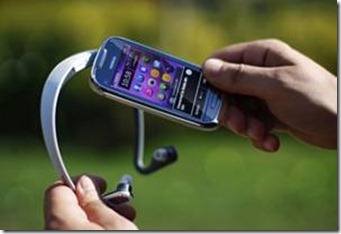
clip_image006
Whilst this is relatively straight forward, the functionality may not be immediately accessible within the menu system and the pairing process can be an inhibitor to using the technology.The most up to date core specification for the Bluetooth standard includes the capability to pair devices via NFC. Simply put, the whole process of activating Bluetooth on both sides, searching, waiting, pairing and authorisation on both sides can be replaced by touching the two devices together. This provides the user with a simple and engaging way to link Bluetooth enabled devices.In a similar manner, users of NFC could “touch to access” a wireless LAN hotspot. Instead of the lengthy process of searching for a hotspot, accessing it and paying for use, a user could simply touch an NFC compatible wireless LAN point and the whole process could be automated, including the payment of any cost from the “virtual wallet” on the device.
 
As the mobile device increasingly becomes the home for digital content, so the ability to easily share this content will become more compelling. NFC can enable an environment where people can touch devices to share business cards, touch to download their photographs to a printer, or touch to share their music with a friend.Furthermore, the NFC enabled mobile device could be used to receive information or a promotion from an advertisement. By embedding an NFC chip within a billboard advertisement or beside a product on the shelf of a retail store, users could touch to receive additional information. For example, an advertisement for a new record could allow users to touch to receive the track listings, download a free ringtone, or access the artist’s mobile internet site. The NFC technology has the potential to significantly impact the marketing and promotions industry, since by touching to receive information the user is proactively taking an interest in a product or service. By sharing information both ways, the marketer can offer users an incentive in exchange for information or interest in a product or service.
 
Identity Management/Business Processes: Almost every office or factory based worker is required to carry an identity tag to access working premises. As businesses become more complex and global in nature, many workers require access to multiple premises.
1354242277
Managing this process can be complicated, even more so in environments where there are different levels of security for different workers.NFC can allow identity management to be added to a mobile device, providing one single integrated solution for identity management. The mobile device can be used to provide access to certain premises and, of course, deny access to others. Importantly, access can be upgraded over the mobile or wireless network, meaning workers are not required to physically visit a site to change their user profile.A further related application would be relevant anywhere that people are required to perform multiple tasks within a busy organisation. For example, a care worker that makes a number of home visits during a working day may “touch to inform” that a particular visit has been completed. The worker can then be assigned a new task based on what is most urgent or where the
professional is located at that time.A security guard could touch on entering and exiting a room, providing a digital footpath of his movements during a patrol. A courier could touch on delivery of a parcel to receive local traffic information and directions to the next collection point.
 
What is required for NFC to succeed?
 
Key Factors for the success of NF: The success of NFC depends upon the creation of a complex yet interoperable environment, supported by a number of different parties. First, there needs to be mobile devices that support the system. This relies on mobile handset manufacturers producing NFC compatible devices. These will also need to come from different vendors, offering the market choice and differentiation. The first NFC compatible mobile devices are now available on the market. Mobile network operators will also need to support NFC. Access to additional data services, and the potential revenues that these could bring through the mobile network, is a critical value add of NFC and the support of the mobile operator community is required to facilitate this. Banks and credit card companies, along with transport operators will also need to engage with NFC.
 
Delivering a required high level of perceived and real security will be essential to the success of NFC and the banks and credit companies have a critical role to play, ensuring the roll out of payment services to NFC devices. Retailers, from shops to restaurants, and from newsagents to coffee shops will need to support and enhance their current offerings with an NFC element. In much the same way as the development of chip and PIN solutions led to the roll out of new hardware in retail, so the development of NFC will facilitate new retail hardware. Retailers will require “touch pads” to facilitate “wave to pay/touch to pay” solutions. Whilst this may seem like a significant investment for retailers, many are already rolling out NFC compatible technology to support payment through transportation cards or the new generation of “wave to pay” credit and debit cards.
 
NFC is an extension of this technology, compatible with the current standards and offering customers further choices as to how to pay. Of course, the roll out of NFC technology within retail is likely to take place over time. Retailers near public transport stations may be early adopters of the technology to provide a service to their customers that are already using contactless solutions for transport. As mass adoption takes place, with increasing numbers of devices commercially available, the roll out of NFC to retail outlets will become ubiquitous. Finally, the developer community is also critically important to the development of NFC. An active developer community with the right tools in place to quickly and effectively bring new solutions to market can add impetus to the technology and offer easily accessible NFC applications to end users.
 
 
Comparison with Bluetooth and other Applications:
NFC and Bluetooth are both short-range communication technologies which are integrated into mobile phones. NFC operates at slower speeds than Bluetooth, but consumes far less power and doesn’t require pairing.
NFC sets up faster than standard Bluetooth, but is not faster than Bluetooth low energy. With NFC, instead of performing manual configurations to identify devices, the connection between two NFC devices is automatically established quickly: in less than a tenth of a second. The maximum data transfer rate of NFC (424 kbit/s) is slower than that of Bluetooth V2.1 (2.1 Mbit/s). With a maximum working distance of less than 20 cm, NFC has a shorter range, which reduces the likelihood of unwanted interception. That makes NFC particularly suitable for crowded areas where correlating a signal with its transmitting physical device (and by extension, its user) becomes difficult.clip_image007
In contrast to Bluetooth, NFC is compatible with existing passive RFID (13.56 MHz ISO/IEC 18000-3) infrastructures. NFC requires comparatively low power, similar to the Bluetooth V4.0 low energy protocol. However, when NFC works with an unpowered device (e.g. on a phone that may be turned off, a contactless smart credit card, a smart poster, etc.), the NFC power consumption is greater than that of Bluetooth V4.0 Low Energy, this is because illuminating the passive tag needs extra power.
 
Standardization bodies and industry projects:
NFC was approved as an ISO/IEC standard on December 8, 2003 and later as an ECMA standard.NFC is an open platform technology standardized in ECMA-340 and ISO/IEC 18092. These standards specify the modulation schemes, coding, transfer speeds and frame format of the RF interface of NFC devices, as well as initialization schemes and conditions required for data collision-control during initialization for both passive and active NFC modes. Furthermore, they also define the transport protocol, including protocol activation and data-exchange methods. The air interface for NFC is standardized in:
ISO/IEC 18092 / ECMA-340
Near Field Communication Interface and Protocol-1 (NFCIP-1)
ISO/IEC 21481 / ECMA-352
Near Field Communication Interface and Protocol-2 (NFCIP-2)
NFC phones that you can buy today:
Android
  • Nexus S
  • Google Nexus S 4G
  • Samsung Galaxy sII (not all versions)
  • Samsung Galaxy Note (not all versions)
  • Galaxy Nexus
  • HTC Amaze 4G
  • Turkcell T20.
S40 & J2ME
  • Nokia 6212 Classic
  • Nokia 6131 NFC
  • Nokia 6216 Classic (Nokia has confirmed the cancellation of this phone in February 2010)
  • Nokia 3220 + NFC Shell
  • Nokia 5140(i) + NFC Shell
S60 & J2ME
  • Nokia 600 (Officially canceled])
  • Nokia 603
  • Nokia 700
  • Nokia 701
  • Nokia C7
  • Nokia C7 and the Nokia Astound and Nokia Oro variants, with the NFC feature enabled starting with the Symbian Anna release of the OS.
J2ME
  • Samsung S5230 Tocco Lite/Star/Player One/Avila[
  • Samsung SGH-X700 NFC
  • Samsung D500E
Bada
  • Samsung Wave 578
MeeGo
  • Nokia N9
BlackBerry
  • Blackberry Bold 9790 (Codename Bellagio)
  • BlackBerry Bold 9900/9930 (Codename Dakota/Montana)
  • BlackBerry Torch 9810/9860
  • Blackberry Curve 9350/9360/9370
Windows Mobile 6.0
  • Benq T80
Other mobiles
  • SAGEM my700X Contactless
  • LG 600V contactless
  • Motorola L7 (SLVR)
  • Sagem Cosyphone
  • Sonim XP1301 CORE NFC
IF U WANT TO ADD ANYTHING,DO POST YOUR OPINIONS THROUGH COMMENTS.